
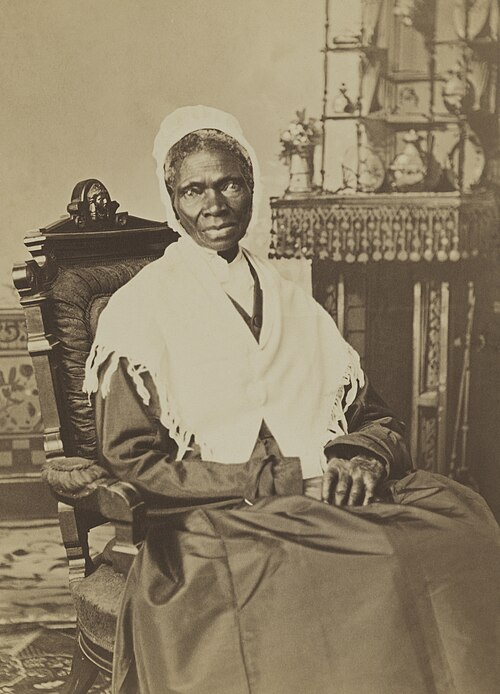
My Heroine, Isabella Baumfree, was born in 1797 to enslaved parents James and Elizabeth Baumfree in Ulster County, New York. After reading about her, it didn’t take long to know she would be my heroine, and it is important to me to reflect as much of her as I can.
“Darlene, you need to find your voice.” Brenda, my coach, explored this idea with me during a session. I love and respect her, but her words were forcing me to confront bringing my emotions into my writing. And emotions aren’t easy for me!
Many writers and speakers talk about ‘finding their voice,’ but this is hard for me. As I pondered, questions like, ‘How and where do I find my voice?’ kept recurring.
My search involved me looking at many writers and websites without any success. What I wanted was a formula: with simple 1, 2, 3 steps, or a method to use. But I found nothing to help me. I continued to think about where to look next and the question, ‘Why do I write and speak?’ This question drew me to another place and time in history.
I thought of the era when women fought for freedom. Freedom for slaves, for voting rights, land, independence, and not like property.
Many women activists in the late 1800s to early 1900s fought for what we enjoy today. One woman, Sojourner Truth. She drew me in. I felt she invited me into her story. She said, “My name is Sojourner Truth,” and she seemed to motion for me to listen.
“Baby, I know what you’re looking for, and I want to give you what I have. The strength and the courage in my voice. The wisdom to know how and when to use my voice, and most of all the willingness to seek God in everything .”
I learned all I could about Sojourner Truth. She was passionate, truthful, strong, and courageous—a woman you’d have to reckon with. Her voice was bold, fearless, and powerful. She embodied traits I admire and a voice I’ve come to love.
In 1851, Sojourner was best remembered for giving the famous speech titled “Ain’t I a Woman” at the Ohio Women’s Rights Convention. Sojourner Truth was winning public opinion. A white publisher altered the text of her speech to make her sound more Southern.
Sojourner Truth, a key abolitionist and women’s rights activist in the 1800s, was born a slave in New York. She lost at least three children to slavery. But she escaped with her infant daughter in 1826. She embraced evangelical religion and joined the reform and abolitionist movements. Her powerful speeches still resonate in the fight for equality. (Editors, 2026)
Sojourner Truth fought for what she believed in. She successfully won the custody of her son and became the first black woman to win a case against a white male. According to a Times Union report, Sojourner Truth was involved in a significant legal case in New York, in which historic court documents detail her efforts to secure her son’s freedom, but there is no evidence that she sued a New York writer for slander and won. Truth is best remembered for her stirring “Ain’t I a Woman?” speech, delivered at a women’s convention in Ohio in 1851. Truth could not read or write; therefore, interpretations were inaccurate. We have no accurate record of her speech. See this link for additional information about Sojourner Truth. https://www.hbook.com/story/reviews-of-select-titles-by-patricia-c-mckissack
Truth spoke about abolition, women’s rights, prison reform, and preached to the Michigan Legislature against capital punishment. Not everyone welcomed her preaching and lectures, but she had many friends and staunch support among many influential people at the time, including Fredrick Douglas, Amy Post, Parker Pillsbury, Frances Gage, Wendell Phillips, William Lloyd Garrison, Laura Smith Haviland, Lucretia Mott, Ellen G. White, and Susan B. Anthony.[63]
Once, a pro-slavery doctor questioned Sojourner’s womanhood and demanded proof. Instead, she exposed her breast to the whole room, declaring, “It is not my shame but yours.” (Liss, 2009) Her confidence met the challenge head-on.
But when I think of Sojourner Truth, I see her confident stature, standing silently and saying, “I dare you.”
After learning about Sojourner, I wondered, “Could I be as strong and as confident as her? Can I find that strength in me?”
Sojourner is an example of strength in the midst of overcoming great pain. She was a woman who deeply cared about the fight that God chose for her.
She endured pain from loss, rejection, love, and injustice before God brought her to the FIGHT. Yet, Sojourner Truth stayed humble, never lost her purpose, and kept her voice strong to the end.
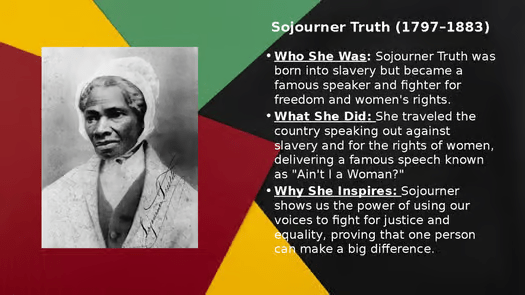
Sojourner Truth made a difference in my life. She motioned me closer as she did from the start, inviting me not only to listen to her voice but to use her voice.
Who is in your life?
- Sojourner has been a mentor, though I never met her. Do you have a Sojourner Truth in your life? You may know your calling, but is God wanting to take you deeper into the calling He has given you?
- Do you have a Brenda who wants to see you be successful in life?
- What does your inner circle look like?
- Are they willing to stand in the gap for you?
These people have been instrumental in my life. Are you pursuing people who encourage and inspire you?
Truth died early in the morning on November 26, 1883, at her Battle Creek home.[64] On November 28, 1883, her funeral was held at the Congregational-Presbyterian Church, officiated by its pastor, the Reverend Reed Stuart.
Frederick Douglass offered a eulogy for her in Washington, D.C. “Venerable for age, distinguished for insight into human nature, remarkable for independence and courageous self-assertion, devoted to the welfare of her race, she has been for the last forty years an object of respect and admiration to social reformers everywhere.”[66][67]
Sojourner Truth’s Legacy (see https://en.wikipedia.org/wiki/Sojourner_Truth}
In 1997, The NASA Mars Pathfinder mission’s robotic rover was named “Sojourner”.[108] The following year, S.T. Writes Home[109] appeared on the web offering “Letters to Mom from Sojourner Truth”, in which the Mars Pathfinder Rover at times echoes its namesake.
In 2014, the asteroid 249521 Truth was named in her honor.[111]
In 2002, Temple University scholar Molefi Kete Asante published a list of 100 Greatest African Americans, which includes Sojourner Truth.[110]
On September 19, 2016, the U.S. Secretary of the Navy Ray Mabus announced the name of the last ship of a six-unit construction contract as USNS Sojourner Truth (T-AO 210).[113] This ship will be part of the latest John Lewis-class of Fleet Replenishment Oilers named in honor of U.S. civil and human rights heroes currently under construction at General Dynamics NASSCO in San Diego, CA.[114]
Resourcestaken from the following websites:
Reviewed in the March/April 1993 issue of The Horn Book Magazine. https://www.hbook.com/story/reviews-of-select-titles-by-patricia-c-mckissack
History.com http://www.history.com/topics/black-history/sojourner-truth+
Hbook.com Patricia and Fredrick McKissackshttp://www.hbook.com/1994/01/authors-illustrators/patricia-c-mckissack-and-fredrick-mckissacks-1993-bghb-nf-speech-for-sojourner-truth-aint-i-a-woman/
Internet Modern History Sourcebook: Sojourner Truth: “Ain’t I a Woman?”, December 1851 http://sourcebooks.fordham.edu/halsall/mod/sojtruth-woman.asp
Isabella Baumfree was born in 1797 to enslaved parents James and Elizabeth Baumfree in Ulster County, New York. https://wams.nyhistory.org/a-nation-divided/antebellum/sojourner-truth/
Sojourner Truth House is a charity http://sojournertruthhouse.org/index.php/about-us/sojourner-truth
Life Story: Sojourner Truth (ca. 1797-1883) https://wams.nyhistory.org/a-nation-divided/antebellum/sojourner-truth/
Discover more from Darlene J. Harris
Subscribe to get the latest posts sent to your email.

Really good article Darlene!
JAN Jan Whitaker GI-KI Goldens Cincinnati, Ohio gikigoldens@gmail.com web site: http://www.gikigoldens.com
LikeLike